Autograph Authentication
Autopen vs. Real Autographs: How to Spot Machine-Signed Memorabilia
A signature can look genuine, contain real ink, and still be produced by a machine. Discover how autopen technology works, why collectors should be concerned, and how AI-assisted authentication can reveal suspicious patterns invisible to the untrained eye.
By Signatrue Team Published on
When a Real Signature Isn't Really Hand-Signed
Imagine purchasing a signed football jersey, trading card, or collectible photograph from your favourite athlete. The signature looks perfect. The ink appears genuine. Every letter matches known examples.
But what if the athlete never actually signed it?
Welcome to the world of autopen technology — where machines can reproduce convincing handwritten signatures using real pens and ink.
At Signatrue, we've recently encountered autograph submissions displaying unusual characteristics that raise concerns about possible mechanical reproduction. Some of these signatures closely resemble genuine examples, yet their execution reveals patterns that deserve closer examination.
The biggest misconception? A signature that looks authentic isn't necessarily personally handwritten.
What Is an Autopen Machine?
An autopen is a mechanical device designed to reproduce a stored handwritten signature.
Unlike a printer or rubber stamp, an autopen physically moves a pen across a surface, depositing real ink while following a predefined signature pattern.
Modern systems can use digitally stored signatures and motor-controlled writing mechanisms to reproduce the same design repeatedly.
Autopen machines have legitimate applications. Public figures, executives, and organisations have used mechanical signing devices for correspondence and other high-volume signing tasks.
However, a problem arises when a mechanically reproduced autograph is presented or sold as though the individual personally signed the collectible.
Real pen. Real ink. But not necessarily a real, personally handwritten autograph.
How Autopen Technology Can Mislead Collectors
A signing machine can reproduce the distinctive curves, proportions, spacing, and overall appearance of a genuine autograph.
This makes mechanically signed memorabilia particularly challenging for collectors relying on visual similarity alone.
A suspicious signature might display:
- Accurate letter formations matching genuine examples.
- Convincing ink deposited directly onto the collectible.
- Highly consistent proportions and spacing.
- Repeated stroke patterns across different items.
- Unusually consistent execution characteristics.
Because the signature can originate from a genuine handwritten example, its overall appearance may be extremely convincing.
The critical question is therefore not simply "Does this look like the celebrity's signature?"
It's "Was this particular autograph personally handwritten?"
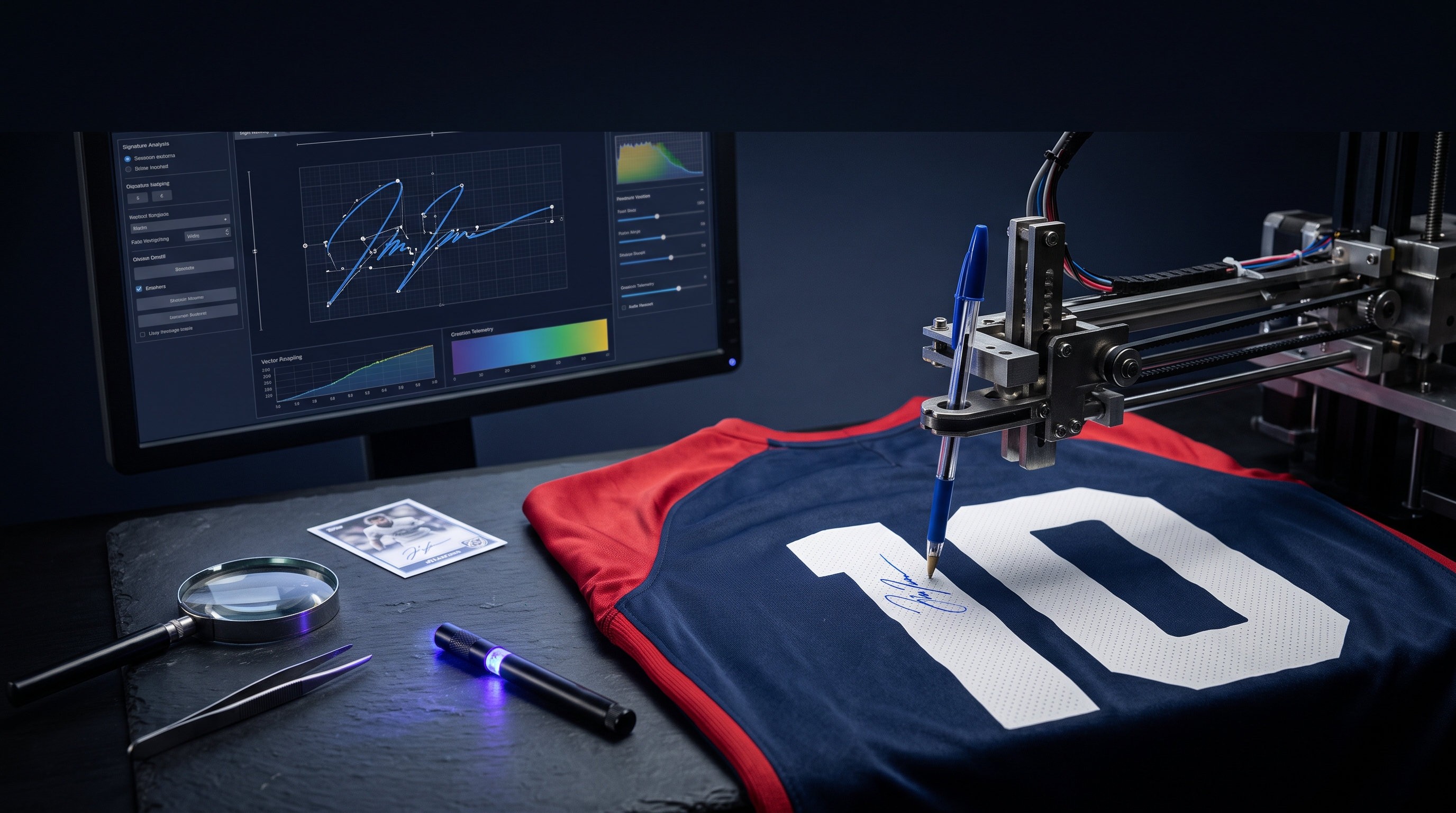
Illustration of an autopen-style signing system reproducing an autograph on sports memorabilia using a computer-controlled pen.
How Can You Spot a Possible Autopen Signature?
Every individual develops characteristic handwriting habits. However, even experienced signers naturally introduce variations from one signature to another.
Changes in writing position, pen angle, movement, surface texture, and signing conditions can influence the finished result.
When examining a suspected mechanically reproduced autograph, several characteristics deserve attention.
1. Unusually Uniform Stroke Execution
Natural handwriting involves complex movements. Writers accelerate, slow down, change direction, and adjust their grip throughout the signing process.
These movements can produce visible differences in ink distribution, stroke width, line quality, and terminal details.
A mechanically reproduced signature may display unusually consistent execution across sections where natural variation might normally be expected.
Importantly, the actual speed of the pen cannot be directly measured from a static photograph. Examiners can assess visible characteristics that may be associated with writing dynamics, but these are indirect indicators.
2. Ink Distribution and Pressure-Related Clues
When someone signs naturally, variations in movement, pen contact, and the writing surface can influence the appearance of the ink.
For example, curved formations, directional changes, and finishing strokes may display different line characteristics.
In some suspicious signatures, the ink appears unusually consistent throughout the writing.
However, visual ink consistency alone does not establish machine use. Different pens, inks, surfaces, and machine settings can produce significantly different results.
3. Pen Lifts, Starting Points, and Finishing Strokes
The beginning and end of a signature can reveal valuable information.
Authentic examples may display habitual starting strokes, characteristic pen lifts, connecting movements, or distinctive finishing trails.
When these features are unexpectedly absent, unusually uniform, or inconsistent with suitable known examples, further investigation may be warranted.
Some mechanical signing systems can also reproduce pen lifts and natural-looking stroke endings. No single characteristic should be treated as definitive proof.
4. Perfect or Near-Perfect Repetition
One of the most revealing clues can emerge when multiple signatures are compared.
Human handwriting has a natural range of variation, even when produced by the same individual.
When separate autographs reproduce an exceptionally similar combination of letter geometry, spacing, connecting strokes, and tiny irregularities, mechanical reproduction becomes an important possibility to investigate.
Comparison against documented autopen patterns can provide additional evidence.
5. The Surface Makes a Difference
Not every autograph is written on ordinary paper.
Collectors encounter signatures on glossy photographs, football shirt numbers, helmets, trading cards, hockey pucks, and textured sporting equipment.
Each surface interacts differently with the pen. Friction, texture, ink absorption, and the position of the object can all affect how a signature appears.
A smooth photograph and a textured synthetic jersey number may produce very different line characteristics, even when signed by the same person.
That's why authentication should consider both the signature and the surface on which it appears.
A Recent Signatrue Assessment: When the Shape Looked Right
In a recent customer submission, our analysis identified an autograph with strong structural similarities to known authentic signatures.
Its letter formations, proportions, and overall geometry appeared convincing.
However, several visible execution characteristics raised concerns:
- Unusually uniform stroke appearance.
- Limited visible variation in ink distribution.
- Few discernible natural pen-lift characteristics.
- Absence of an expected finishing detail.
- Exceptionally consistent structural reproduction.
Although these observations raised the possibility of an autopen or similar mechanical signing process, the available images could not conclusively establish how the signature had been produced.
The assessment was classified as Likely Not Genuine as a personally handwritten autograph.
The lesson is simple: matching the appearance of a genuine signature is not enough. The execution characteristics matter too.
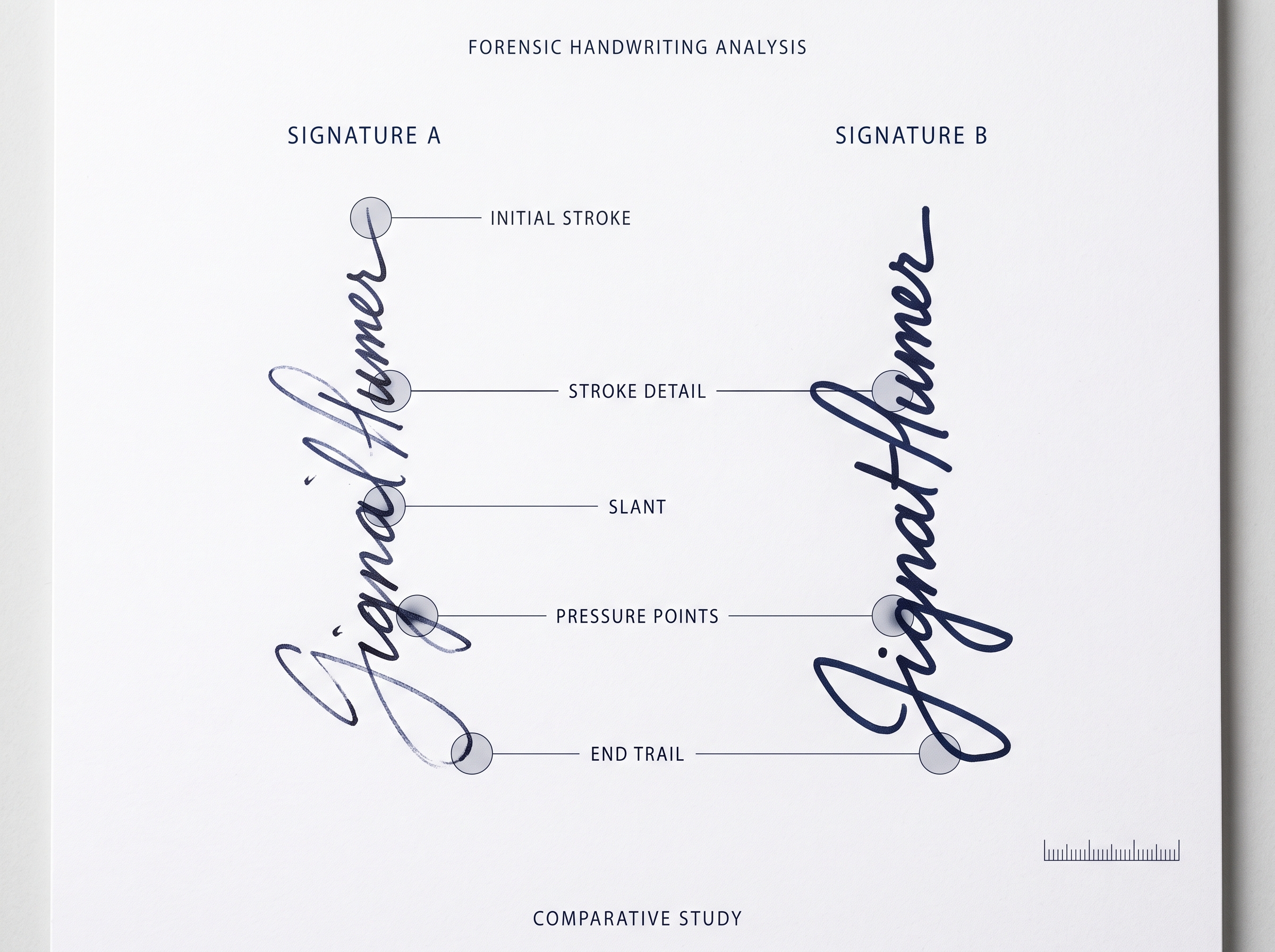
Illustrative comparison of handwriting features examined during autograph authentication. No single visual characteristic establishes autopen use.
How Signatrue Uses AI to Examine Suspicious Autographs
Traditional autograph assessment relies on examining handwriting characteristics, relevant reference material, and the history of an item.
At Signatrue, we use machine-learning-assisted analysis to help assess visible signature characteristics and identify potential inconsistencies.
Depending on the quality of the images and available references, our analysis can consider:
- Stroke structure: letter formations, connections, and overall geometry.
- Line quality: visible consistency and irregularities throughout the writing.
- Slant and alignment: directional relationships and baseline progression.
- Ink characteristics: visible distribution, changes in line width, and possible pressure-related clues.
- Pen lifts and finishing strokes: the presence or absence of characteristic details.
- Comparison patterns: similarities and differences relative to suitable authenticated examples.
Our approach considers the combination of available characteristics rather than relying on one visual warning sign.
AI-assisted image analysis has important limitations. A photograph does not directly record the movement speed or physical pressure of the pen. Image resolution, lighting, reflections, and surface texture can also obscure or distort important details.
For this reason, an assessment can identify characteristics consistent with possible mechanical reproduction without conclusively identifying the equipment or method responsible.
Before Buying a Signed Collectible: Five Things to Check
- Research the seller. Review their reputation, item description, and return policy.
- Examine the signature. Look closely at the ink, starting strokes, finishing details, and overall execution.
- Compare suitable examples. Consider known signatures from a similar period and, where possible, the same type of item.
- Investigate provenance. Look for credible information about when, where, and how the autograph was obtained.
- Consider an independent assessment. Obtain additional evidence before committing to an expensive purchase.
A Certificate of Authenticity can form part of an item's documentation, but its evidential value depends on who issued it and the examination supporting it.
Frequently Asked Questions
Is an autopen signature considered a genuine autograph?
An autopen may reproduce a genuine person's signature design using real ink. However, the individual item was not personally handwritten by that person. Collectors should distinguish between an authorised mechanical signature and a personally signed collectible.
Can an autopen signature be identified from a photograph?
Photographs can sometimes reveal suspicious characteristics, especially when high-quality images and suitable comparison examples are available. However, determining the precise production method may require examination of the physical item and additional evidence.
Does a perfectly matching signature mean it is fake?
Not necessarily. Genuine signatures can be remarkably consistent. Repeated, near-identical details across separate examples can be a warning sign, but conclusions should consider the full available evidence.
Can AI guarantee that a signature is genuine?
No. AI can support autograph assessment by examining visible characteristics and comparison patterns, but it cannot guarantee authenticity or eliminate every possibility of forgery.
Don't Just Trust the Signature. Check It.
Autopen technology demonstrates why autograph authentication requires more than recognising familiar handwriting.
A convincing signature can still raise important questions about how it was produced.
Whether you're considering a signed football shirt, trading card, photograph, helmet, or another collectible, understanding the warning signs can help you make more informed decisions.
At Signatrue, our mission is to make autograph assessment more accessible through AI-assisted technology and informed review.
Have an autograph you're unsure about?
Explore our Rapid Review and Pre-Authentication services.
Visit Signatrue.ai and submit your autograph for assessment.
Important: Autograph assessments express an opinion based on the information and evidence available. Findings indicating possible mechanical reproduction should not be interpreted as definitive identification of a particular machine or signing process.